 Preview unavailable.
Use the source link to view the original.
400 × 397 px · JPEG · The full frame
Sain (Recordiau) Cyf. · CC BY-SA 3.0
More to discover
 Goreuon Richie Thomas (Tenor) / Best Of Richie Thomas (Tenor)
Sain (Recordiau) Cyf. · CC BY-SA 3.0
 Er Mwyn Yfory
Sain (Recordiau) Cyf. · CC BY-SA 3.0
 Bling
Sain (Recordiau) Cyf. · CC BY-SA 3.0
 Can O Gymru / A Souvenir Of Wales In Song
Sain (Recordiau) Cyf. · CC BY-SA 3.0
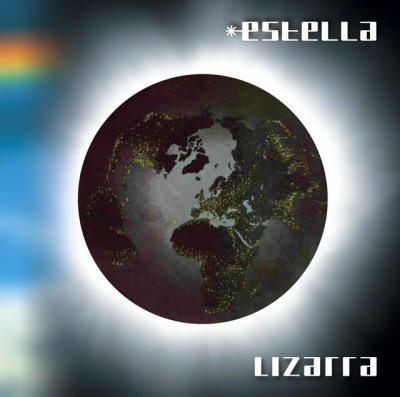
Lizarra
Estella
Album artwork for Estella, provided through the SAIN Records collection on Wikimedia Commons.
Inside the image.
A square cover centres on a large, nearly circular image of the Earth, viewed from space. The globe sits slightly above the midpoint and fills most of the central area, with Europe and Africa prominent: the grey-white Arctic and northern regions lie near the top, while the African continent extends down towards the lower centre. The surface is very dark, with scattered yellow, green and reddish points of light suggesting illuminated land and coastlines. The globe’s edge is clearly defined against a bright, hazy halo.
Behind it, the background shifts from blue and teal along the left side to pale grey and white around the globe, then to charcoal and black towards the right and lower edges. A blurred horizontal band of yellow, orange and green appears near the upper left. The glow around the Earth is strongest at its top and sides, creating a luminous rim and a sense of depth; there is no visible border.
White lettering occupies two corners. At the upper right, a small asterisk-like mark precedes the stylised word “ESTELLA”; the uppercase letters are angular and tightly spaced. At the lower right, “LIZARRA” appears in larger, widely spaced capitals with rounded, geometric forms. Both inscriptions sit over the darkened background, clear of the globe. The image combines a photographic-looking planetary view with a strongly softened, high-contrast surrounding field.
What the image evokes.
The glowing Earth seems suspended between a night sky and a field of diffuse light. Its scattered points make the continents feel inhabited, yet the almost black surface gives the planet a remote, quiet quality. The halo might suggest sunrise seen from orbit, or the flare of a lamp behind a dark sphere; the image holds both cosmic distance and the familiar geography of Europe and Africa in view.
The blurred strip of colour at the upper left introduces a more abstract, almost signal-like note. Set against the globe’s recognisable form, it makes the cover feel poised between a space photograph and a graphic composition. The restrained white lettering keeps to the margins, while its angular shapes echo the sharpness of the planet’s outline. Overall, the image can read as both expansive and contained: a whole world enclosed within a neat circle, bright at its edge and dark at its core.
Associations are subjective readings, rather than documented influences or statements of the artist’s intention.
Read. Share. Reimagine.
These visual notes are offered under CC BY 4.0. Credit dbcovers, link to the source, keep the licence information and indicate any changes.
Ready-to-use attribution
Other attribution formats are allowed when reasonable for the medium and context. The artwork has its own separate licence.
Lettering & observation notes
- *ESTELLA — Upper right
- LIZARRA — Lower right
Artwork sources & licence.
Credit the author and source, link to the licence and indicate any changes. Share adaptations under compatible terms. Read the full licence for details.
- Source year
- 2003
- Source author field
- Sain (Records) Ltd
- Attribution
- Sain (Recordiau) Cyf.
- Collection
- SAIN / Wikimedia Commons
- Catalogue number
- SAIN SCD 2432
- Permission evidence
- Public VRT notice: 2017050910011681
- Source checked
- 20 October 2026

Year as recorded on the source file page; it may not represent the work’s first release. File unchanged; browser preview scaled proportionally.