 Preview unavailable.
Use the source link to view the original.
400 × 397 px · JPEG · The full frame
Sain (Recordiau) Cyf. · CC BY-SA 3.0
More to discover
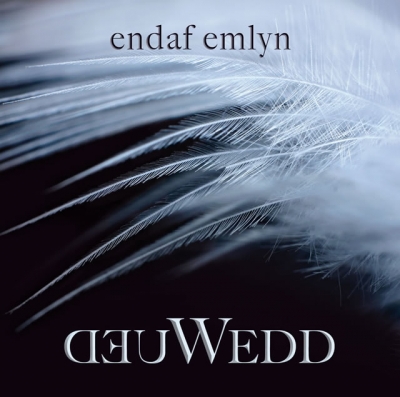 Deuwedd
Sain (Recordiau) Cyf. · CC BY-SA 3.0
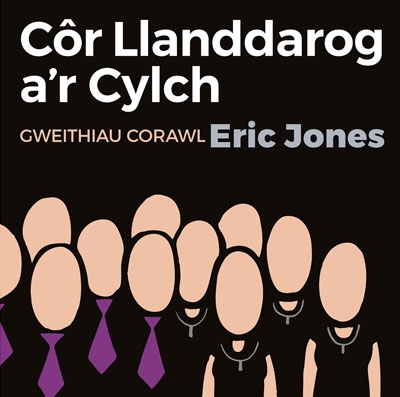 Gweithiau Corawl Eric Jones
Sain (Recordiau) Cyf. · CC BY-SA 3.0
 Caneuon Meirion Williams / The Songs Of Meirion Williams
Sain (Recordiau) Cyf. · CC BY-SA 3.0
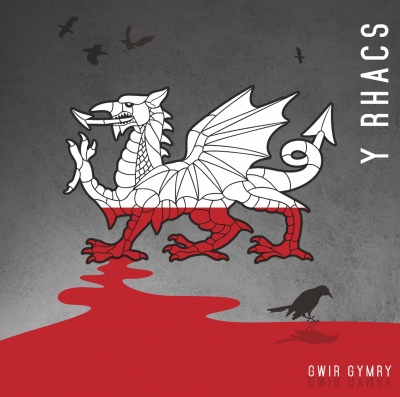 Gwir Gymry
Sain (Recordiau) Cyf. · CC BY-SA 3.0
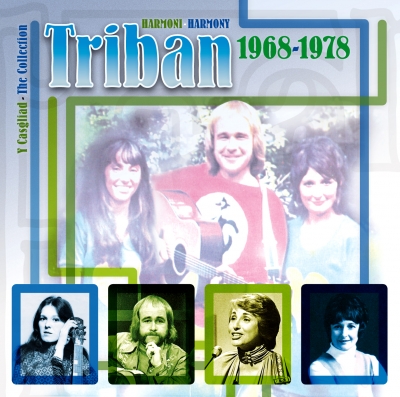
Y Casgliad / The Collection (1968
Triban
Album artwork for Triban, provided through the SAIN Records collection on Wikimedia Commons.
Inside the image.
A square album-cover design combines a faded central group photograph with large lettering and four smaller portrait panels along the bottom. In the main photograph, three people stand close together: a long-haired woman on the left, a fair-haired man in the centre holding an acoustic guitar, and a dark-haired woman on the right. They are shown from about the waist up against a soft, indistinct outdoor-looking background. The man wears a red top with a pale circular motif; the women wear light-coloured tops. The photograph is washed out and slightly hazy, with pale pink, blue, green and red tones.
A network of thick, squared-off blue and olive-green lines frames and partly overlaps the photograph. The blue line runs around the upper and left portions of the cover, while the green line forms a lower, offset rectangular path that crosses in front of the photograph and continues towards the bottom. Their rounded corners and uneven overlaps give the layout a layered, graphic structure. A pale grey-white ground fills the spaces around the image and carries faint, broad geometric marks.
The title dominates the top: “Triban” appears in very large, ornate blue lettering with a light outline and shadow, extending across the upper left and centre. Above it, smaller green text reads “HARMONI · HARMONY”. To the right, “1968-1978” is set in bold green numerals. Along the far left edge, narrow blue vertical lettering reads “Y Casgliad · The Collection”.
Four small, square portrait photographs sit in a row across the lower edge, each enclosed by a differently coloured frame: blue, green, yellow-green and blue from left to right. They show the long-haired woman, the fair-haired man, another woman in profile at a microphone, and a dark-haired woman in a light top. The portraits are monochrome or strongly tinted, with the frame colours showing through their pale backgrounds. The bottom panels partly cover the larger photograph and the green line. The overall treatment is a collage of photographs, bold display lettering and flat geometric framing; the images appear soft and somewhat faded.
What the image evokes.
The squared paths suggest a frame that has been loosened and allowed to wander: they guide the eye around the central group, then break away into the row of smaller portraits. The result feels both orderly and informal, as though a carefully arranged cover has been assembled from collected pieces rather than built around a single uninterrupted photograph.
The contrast between the oversized, decorative title and the subdued group image gives the design a commemorative quality. The lower portraits read like glimpses from a wider archive, while the central trio remains the human focus. The pale, hazy colours make the people seem partly held in memory; the saturated blue and green lines, by comparison, feel crisp and present. That tension gives the cover a gentle sense of looking back without making it solemn.
The typography and colour blocks can call to mind late-1960s or 1970s printed graphics, though the cover alone cannot establish a particular design tradition or date of production. Its mixture of formal lettering, softened photographs and simple framing also has something of a scrapbook or keepsake about it: a public title enclosing intimate, individual faces.
Associations are subjective readings, rather than documented influences or statements of the artist’s intention.
Read. Share. Reimagine.
These visual notes are offered under CC BY 4.0. Credit dbcovers, link to the source, keep the licence information and indicate any changes.
Ready-to-use attribution
Other attribution formats are allowed when reasonable for the medium and context. The artwork has its own separate licence.
Lettering & observation notes
- Triban — Large across the upper left and centre
- HARMONI · HARMONY — Small lettering above “Triban” near the top centre
- 1968-1978 — Upper right
- Y Casgliad · The Collection — Vertically along the far left edge
Artwork sources & licence.
Credit the author and source, link to the licence and indicate any changes. Share adaptations under compatible terms. Read the full licence for details.
- Source year
- 2011
- Source author field
- Sain (Records) Ltd
- Attribution
- Sain (Recordiau) Cyf.
- Collection
- SAIN / Wikimedia Commons
- Catalogue number
- SAIN SCD 2637
- Permission evidence
- Public VRT notice: 2017050910011681
- Source checked
- 20 October 2026

Year as recorded on the source file page; it may not represent the work’s first release. File unchanged; browser preview scaled proportionally.