 Preview unavailable.
Use the source link to view the original.
400 × 397 px · JPEG · The full frame
Sain (Recordiau) Cyf. · CC BY-SA 3.0
More to discover
 Hyn
Sain (Recordiau) Cyf. · CC BY-SA 3.0
 Adre’N Ôl
Sain (Recordiau) Cyf. · CC BY-SA 3.0
 Storm Nos
Sain (Recordiau) Cyf. · CC BY-SA 3.0
 Distaw
Sain (Recordiau) Cyf. · CC BY-SA 3.0
Eurocantica
Eurocantica
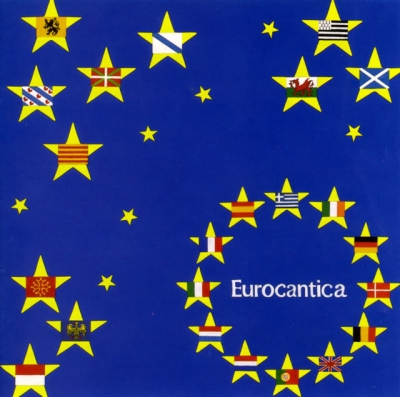
Album artwork for Eurocantica, provided through the SAIN Records collection on Wikimedia Commons.
Inside the image.
A square cover shows a deep, even cobalt-blue field scattered with bright yellow five-pointed stars. Many of the stars are larger and decorated with small, differently coloured geometric motifs; others are plain, tiny stars. The main arrangement curves around the lower and right portions of the cover, loosely enclosing the white word “Eurocantica” just below and to the right of centre. A few isolated small stars punctuate the open blue space, especially across the upper half and at the left.
The decorated stars vary in scale and detail. At the top left, one large star contains a small dark heraldic-looking figure; near the top centre is a star with blue and white diagonal sections. A star near the top right has black and white horizontal bands, while stars across the upper left and right include red, white, blue, green and yellow blocks, stripes and cross-like designs. More patterned stars descend along the left edge, including a red-and-yellow striped one and a red starburst-like motif. In the lower half, the stars form a broken wreath or crescent that sweeps from the left bottom corner, across the lower edge and up the right side. These include further bands, checks, crosses and colour blocks, with small dark marks or emblem-like shapes in a few. The motifs are too small to identify more specifically.
The stars and lettering are flat, graphic shapes without visible shading or depth. The yellow is vivid against the saturated blue, while the red, white, green and black details create small points of contrast. The arrangement leaves a broad, relatively open area of blue through the middle and upper centre. There is no visible border. “Eurocantica” is set in simple white sans-serif lettering, medium-sized in relation to the cover, on a single horizontal line; it sits within the opening of the star arc and is the only readable text. The image has a slightly soft, low-resolution appearance, but no distinct surface texture is apparent.
What the image evokes.
The scattered stars suggest a night sky at first glance, though their flat yellow fill and the little flags, stripes and emblems inside many of them make the field feel more like a collection of signs than distant celestial bodies. The decorated shapes have the charm of small badges or hand-cut paper ornaments: each one carries its own pattern, and together they turn the loose crescent into a procession around the lettering.
There is a pleasing tension between order and play. The stars appear to orbit a centre, but the spacing is irregular and several drift away on their own, as if the arrangement were still in motion. The large, uninterrupted blue area gives the image a calm, expansive quality; the bright yellow forms, by contrast, feel buoyant and almost childlike. The result can call to mind a page of international symbols reimagined as a constellation, though the individual designs remain too small to read precisely. It feels festive and gently ceremonial, with the central word held in a quiet clearing amid the coloured marks.
Associations are subjective readings, rather than documented influences or statements of the artist’s intention.
Read. Share. Reimagine.
These visual notes are offered under CC BY 4.0. Credit dbcovers, link to the source, keep the licence information and indicate any changes.
Ready-to-use attribution
Other attribution formats are allowed when reasonable for the medium and context. The artwork has its own separate licence.
Lettering & observation notes
- Eurocantica — Slightly right of centre, in the lower-middle area
Artwork sources & licence.
Credit the author and source, link to the licence and indicate any changes. Share adaptations under compatible terms. Read the full licence for details.
- Source year
- 1993
- Source author field
- Sain (Records) Ltd
- Attribution
- Sain (Recordiau) Cyf.
- Collection
- SAIN / Wikimedia Commons
- Catalogue number
- Sain SCD2047
- Permission evidence
- Public VRT notice: 2017050910011681
- Source checked
- 20 October 2026

Year as recorded on the source file page; it may not represent the work’s first release. File unchanged; browser preview scaled proportionally.